
The Prime Minister of India has called for conserving foreign exchange reserves as rising global oil prices and the ongoing West Asia crisis put pressure on the rupee and India’s external finances.
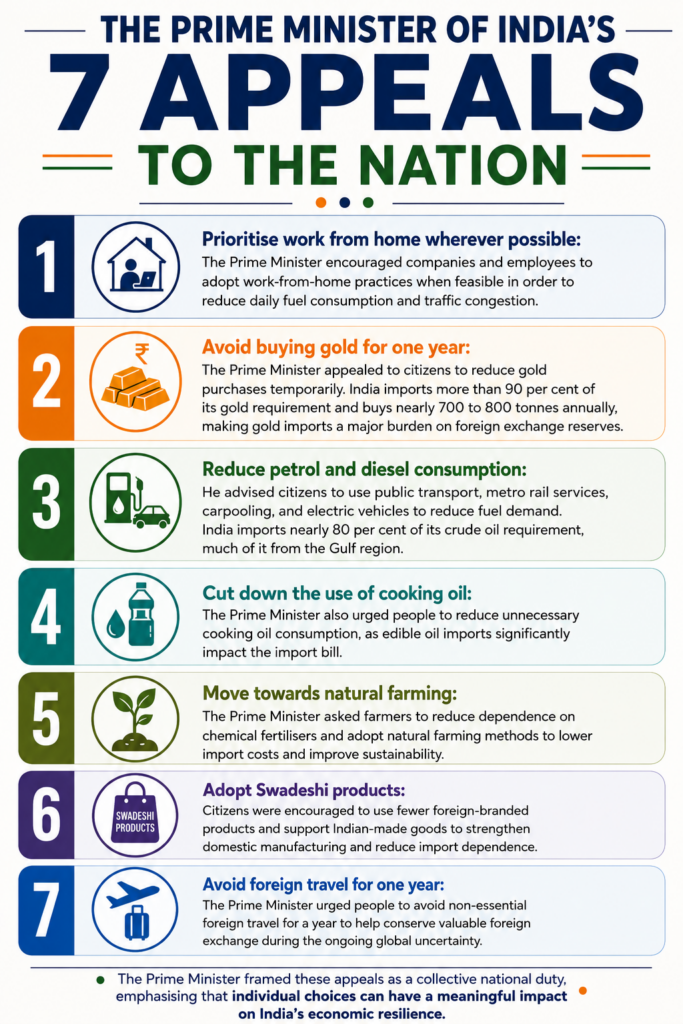
In response, policymakers are considering measures such as attracting diaspora deposits, easing capital inflows, curbing non-essential imports like gold, reducing overseas remittances, and promoting fuel conservation. The RBI is also intervening in currency markets to stabilise the rupee and manage dollar demand. The rupee has already touched an all-time low of ₹95.68 to the dollar.
The most visible policy action so far has been a hike in the gold import duty from 6% to 15%, effective May 13, 2026. The Basic Customs Duty (BCD) was revised from 5% to 10%, and the Agriculture Infrastructure and Development Cess (AIDC) from 1% to 5%.
India’s External Sector Vulnerabilities
India runs a structurally negative current account, meaning it imports more than it exports. This deficit is financed by capital inflows of foreign direct investment (FDI), foreign portfolio investment (FPI), and external borrowings. When inflows slow or the import bill rises, the current account deficit (CAD) widens and pressure builds on the rupee and foreign exchange reserves.
Two commodities drive the bulk of India’s import bill: crude oil and gold.
India imports nearly 90% of its crude oil and around half of its natural gas. At elevated oil prices, the annual energy import bill can exceed $150–160 billion. The Strait of Hormuz blockade through which 20% of global oil flows has pushed prices higher, raising India’s import costs.
Gold adds a second layer of pressure. India produces almost no gold domestically. In 2025–26, it spent a record $71.98 billion on gold imports, equivalent to 9–10% of the total import bill. Gold imports do not directly contribute to productive economic activity. They are driven by investment demand and cultural consumption, making them a target for demand management.
What Can India Do? Policy Toolkit
1. Compress Non-Essential Imports to Narrow the Trade Deficit
The most direct lever is reducing imports that drain foreign exchange reserves without contributing to productive economic activity. The gold import duty hike is the clearest example. Gold is a “non-productive import”, it does not feed into manufacturing, exports, or GDP growth the way machinery or industrial raw materials do. Reducing gold imports by 30–40% could conserve $20–25 billion annually in foreign exchange reserves.
The duty hike on gold and silver is expected to curb imports, reduce foreign exchange outflows, and help narrow the trade deficit. However, the trade-off is significant. Gold futures rose 7.2% after the announcement, signalling higher domestic prices. This could raise working capital costs for jewellers and bullion traders, weaken consumer demand, and revive gold smuggling networks that had declined after tariff cuts in 2024.
Additionally, the government has introduced concessional rates for recycling and recovery categories to push the sector toward domestic gold reuse over fresh imports. India can also review other discretionary imports such as luxury goods and consumer electronics for further forex conservation without damaging productive capacity.
2. Reduce the Oil Import Bill Through Demand and Supply Measures
India can pursue two parallel strategies on crude oil: reducing consumption and diversifying supply sources.
On the demand side, every reduction in fuel consumption translates into savings on the oil import bill and supports foreign exchange reserves. The International Energy Association (IEA) notes that over 40 countries have adopted fuel conservation measures from four-day workweeks in Pakistan and the Philippines to odd-even driving in South Korea to air-conditioning caps in Bangladesh, Cambodia, and Thailand.
India can deploy:
- Work-from-home for government employees on specified days, reducing commuter fuel demand
- Public transport and carpooling through fare subsidies and employer tax credits
- EV adoption in government fleets to reduce petroleum dependence
- Fuel efficiency norms for commercial vehicles
On the supply side, India has expanded crude oil sourcing from Russia at prices below global benchmarks. Deepening partnerships with non-Gulf suppliers in Africa and Latin America can reduce India’s exposure to Hormuz disruptions.
3. Boost Dollar Inflows Through the Capital Account
NRI Deposits
India has used Non-Resident Indian (NRI) deposit schemes to mobilise dollar inflows during past crises. In 2013, the RBI launched a special Foreign Currency Non-Resident Bank (FCNR(B)) swap scheme that attracted $34 billion in NRI deposits within weeks, supporting foreign exchange reserves. A similar scheme offering above-market interest rates on foreign currency deposits can be redeployed.
FDI and ECB Liberalisation
Foreign Direct Investment is a stable form of capital inflow because it is long-term and not subject to reversal. Fast-tracking approvals in manufacturing, logistics, and data infrastructure can accelerate FDI inflows. Easing External Commercial Borrowing (ECB) norms can allow Indian companies to raise foreign currency debt, increasing dollar supply in the economy.
Sovereign Bond Issuance
India has been cautious about issuing sovereign bonds in foreign currency due to currency risk. A targeted issuance with hedging structures could attract foreign investor interest and augment foreign exchange reserves.
4. Tighten Outward Remittances Under the Liberalised Remittance Scheme
The Liberalised Remittance Scheme (LRS) allows Indian residents to remit up to $250,000 per year abroad for education, travel, and investment. During periods of rupee depreciation, these outflows add to dollar demand without a productive return.
The government raised Tax Collected at Source (TCS) on LRS remittances above ₹7 lakh to 20% in a previous budget. Further tightening of targeting overseas investment and foreign travel remittances can reduce non-essential dollar outflows.
When foreign exchange reserves are under stress, the priority must be to preserve dollars for essential imports (crude oil, defence equipment, industrial machinery) over discretionary overseas spending.
5. RBI’s Role in Managing the Rupee
The RBI manages pressure on the rupee through a mix of market intervention, monetary policy, and liquidity measures. It sells dollars from the finite foreign exchange reserves to reduce excessive volatility.
Higher interest rates can attract foreign capital inflows and support the rupee, but they also raise borrowing costs and may slow economic growth. This shows RBI’s constant struggle to balance monetary independence, exchange rate stability, and financial openness. The RBI can also rely on bilateral currency swap arrangements with central banks such as the US Federal Reserve or the Bank of Japan to access dollar liquidity during periods of stress without sharply depleting reserves.
In addition, tightening timelines for exporters to repatriate foreign earnings can increase domestic dollar supply and ease depreciation pressure on the rupee.
Conclusion
India’s foreign exchange reserves are the economy’s buffer as they allow India to pay for essential imports, service external debt, and maintain investor confidence when global conditions deteriorate.
The stress is driven by structural vulnerabilities: oil import dependence, gold consumption, and a current account deficit that needs capital inflows to finance. Addressing these requires coordination across the gold import duty regime, fuel conservation policy, capital inflow incentives, LRS management, and RBI monetary tools.
Master Digital Age Governance & Technology Trends with VisionIAS Comprehensive Current Affairs →
India’s foreign exchange FAQs
1. Why is India trying to conserve foreign exchange reserves in 2026?
Ans. Due to rising global oil prices and rupee pressure from the West Asia crisis.
2. What NRI deposit scheme did India use during the 2013 currency crisis?
Ans. The RBI’s special FCNR(B) swap scheme, which raised $34 billion.
3. What fuel conservation measures can India adopt to reduce its oil import bill?
Ans. Work-from-home mandates, public transport subsidies, EV adoption in government fleets, and carpooling incentives.
4. How does the RBI support the rupee during depreciation pressure?
Ans. By selling dollars from reserves, adjusting interest rates, and entering bilateral forex swap arrangements.
5. Which two commodities drive the bulk of India’s import bill?
Ans. Crude oil and gold.

Leave a Reply