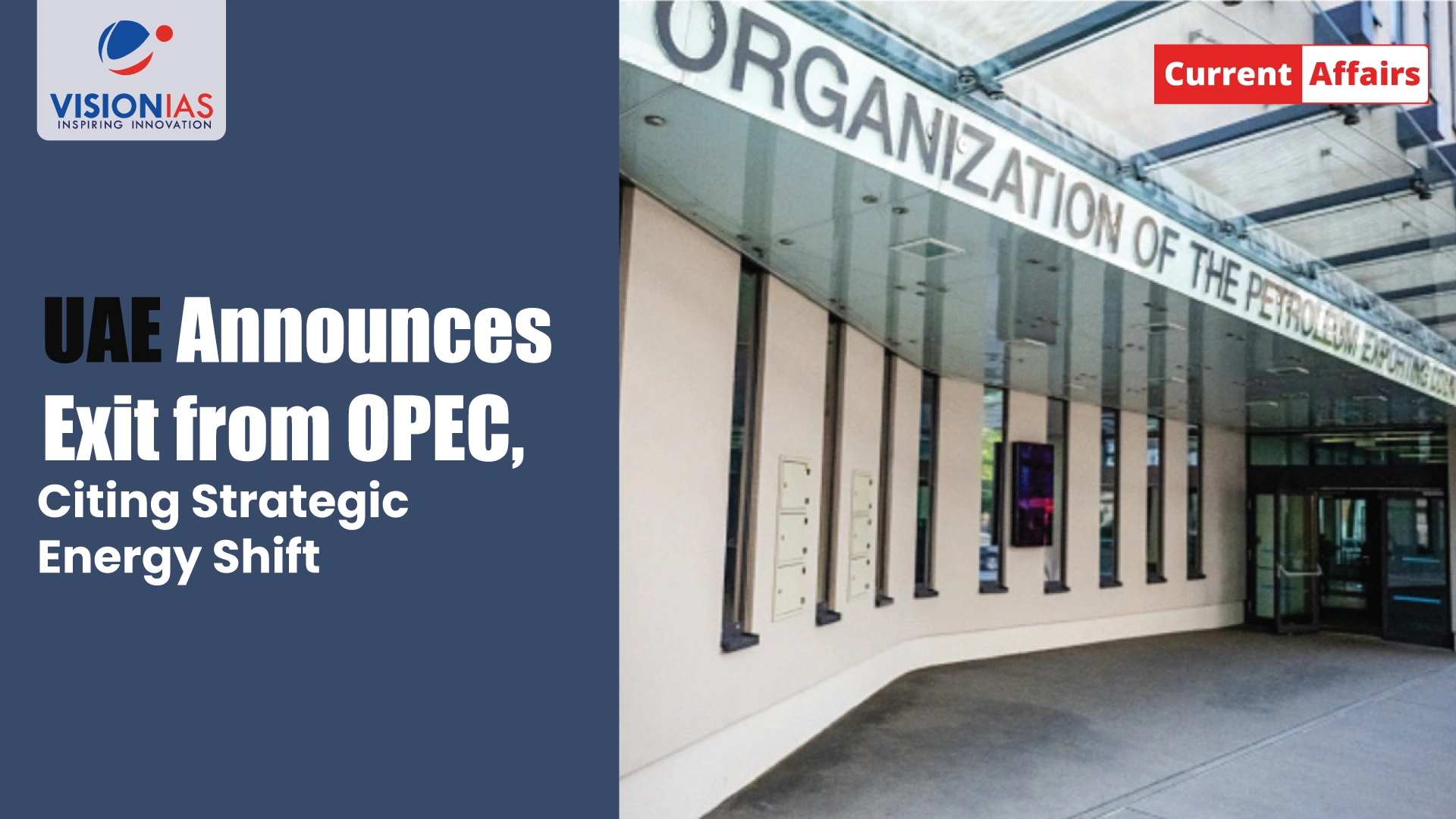
The United Arab Emirates quit OPEC and OPEC+, dealing a major blow to the oil producers’ bloc and Saudi Arabia amid the Iran war–driven energy shock and growing global economic uncertainty.
The United Arab Emirates (UAE) has officially announced its exit from OPEC and OPEC+, effective May 1, 2026. Citing a shift in its long-term energy policy, the move is expected to weaken OPEC’s cohesion, reshape oil market dynamics, and raise concerns over global price stability.
The decision comes amid the ongoing US-Iran war, which has caused an energy shock and unsettled the global economy. The UAE’s exit reflects its focus on energy diversification, national interests, and an independent role in shaping future energy markets with implications for oil-importing nations like India.
What Is OPEC, and Why Did the UAE Join?
Founded in September 1960 at the Baghdad Conference in Iraq, the Organisation of Petroleum Exporting Countries (OPEC) was established by five founding members: Iran, Kuwait, Iraq, Saudi Arabia, and Venezuela.
Before OPEC’s formation, Western multinational oil companies often called the “Seven Sisters” largely dictated the prices paid to oil-producing nations. OPEC was created to counter this dominance by coordinating the petroleum policies of member states, ensuring stable returns from their oil exports.
The UAE formally joined the alliance in 1967, six years before OPEC’s oil embargo on the United States and Netherlands following the Arab-Israeli war. That embargo caused oil prices to nearly quadruple, cementing OPEC’s geopolitical leverage on the global stage.
In 2016, OPEC+ was created, a broader alliance that brought in non-OPEC producers, including Russia. Formed in response to America’s shale oil production, OPEC+ today produces roughly 40% of the world’s crude oil and accounts for 60% of internationally traded petroleum, according to the US Energy Information Administration (EIA).
How Does OPEC Control Global Oil Prices?
OPEC functions much like a central bank for the global oil market. Its primary tool is supply management regulating production limits and setting quotas for each member country.
Production Quotas
Under OPEC’s quota system, a member state may not be permitted to produce at its full capacity. These limits are designed to prevent oversupply during periods of reduced global demand, protecting per-barrel pricing from a sharp crash.
OPEC also has the ability to increase collective production during supply shortages, preventing prices from rising sharply. For member nations reliant on oil revenues, these quotas serve as a buffer against domestic budget shocks.
However, for the UAE which has expanded its oil infrastructure, these quotas have become a constraint on production growth.
Why Did the UAE Leave OPEC?
The US-Iran War and Regional Security
The Strait of Hormuz through which nearly a fifth of the world’s oil transport once passed has seen shipping activity reduced due to Iranian threats and attacks on Gulf vessels and infrastructure.
With Iran a founding member of OPEC, the alliance’s consensus-based decision-making has limited the UAE’s options diplomatically. Exiting OPEC removes these constraints, allowing the UAE to independently use its oil supply to forge new strategic partnerships.
Production Beyond OPEC Quotas
The state-owned Abu Dhabi National Oil Company (ADNOC), backed by a $150 billion investment, had set a target of increasing the UAE’s maximum sustainable crude oil production to 5 million barrels per day by 2027. OPEC’s quotas had consistently forced the UAE to underutilise both its infrastructure and natural deposits.
UAE Energy Minister Suhail al-Mazrouei confirmed that a review of “current and future policies related to level of production” was central to the decision to leave.
Shift Toward a Post-Oil Economy
The UAE has been diversifying its economy expanding into education, technology, and finance. Achieving this vision of a knowledge-based economy requires generating more oil revenue in the short term to fund the transition. OPEC’s quota system was a direct obstacle to this goal.
What Does This Mean for Global Oil Prices?
The UAE’s departure will weaken OPEC as an institution. The alliance’s influence rests on collective member action and control over global spare capacity, the volume of crude oil that can be brought online within 30 days and sustained for at least 90 days.
This spare capacity has historically been held by Kuwait, Saudi Arabia, and the UAE. With the UAE now operating independently and expanding output, OPEC will face direct competitive pressure.
Downward Pressure and Volatility
This competition will push oil prices downward and introduce greater market volatility, adding to the disruptions already caused by the US-Iran war.
- Short-term: Downward pressure reduces the cost per barrel for oil-importing nations.
- Medium-term: Greater supply-side competition could expand the pool of oil suppliers globally.
- Long-term: Other OPEC members, including Saudi Arabia, may also consider abandoning their quotas, potentially weakening the alliance further.
Impact on India
For India, one of the world’s largest oil importers, the UAE’s exit from OPEC carries both opportunities and risks.
In the short term, lower global oil prices reduce India’s import bill, a benefit for a country that imports over 85% of its crude oil requirements. Cheaper oil also eases inflationary pressure across fuel-dependent sectors.
In the medium to long term, an independent UAE could offer India greater supply flexibility, price negotiations outside the cartel framework, and new bilateral energy agreements. It may also support India’s de-dollarisation efforts by expanding discussions on oil trade settlement in rupees, building on recent moves toward local currency trade with key partners.
Greater use of rupee-based energy transactions could strengthen India-UAE economic ties, reduce exchange rate risks, and advance India’s push to internationalise the rupee. However, increased market volatility makes energy budgeting and planning more difficult for import-dependent economies.
Conclusion
The UAE’s exit from OPEC and OPEC+ marks a turning point in global energy geopolitics. Driven by security concerns arising from the US-Iran war, constrained production capacity, and a long-term vision of economic diversification, the UAE has chosen to chart an independent course.
The decision weakens OPEC at a time when the alliance is already under strain. As the UAE expands production freely, the effects on global oil pricing, OPEC’s future, and India’s energy security will be closely watched.
Master Digital Age Governance & Technology Trends with VisionIAS Comprehensive Current Affairs →
UAE’s OPEC exit FAQs
1. When will the UAE officially exit OPEC?
Ans. May 1, 2026.
2. Why did the UAE leave OPEC?
Ans. To expand oil production beyond OPEC quotas, fund its post-oil economy, and gain diplomatic independence amid the US-Iran war.
3. When was OPEC founded?
Ans. September 1960.
4. When did the UAE join OPEC?
Ans. 1967.
5. How will the UAE’s OPEC exit affect global oil prices?
Ans. It will create downward pressure on prices and increase market volatility.

Leave a Reply