
Introduction
The Union Public Service Commission’s Civil Services Examination (UPSC CSE) is a beacon for those aspiring to serve in India’s prestigious civil services. However, the path to achieving this dream is full of challenges, particularly managing one’s time effectively within an extensive syllabus and the rigors of daily life. The key to conquering this colossal task lies in smart preparation strategies tailored to navigate the complexities of the UPSC CSE.
In this comprehensive blog, we delve into the art of time management, a crucial skill set for UPSC aspirants aiming for success. By breaking down the preparation process into manageable segments, setting realistic goals, and adopting a disciplined approach, aspirants can not only cover the vast syllabus but also ensure ample time for revision and self-care, ultimately leading to a balanced and effective preparation journey.
Understanding UPSC CSE Preparation Requirements
The UPSC Civil Services Exam preparation is renowned for its extensive syllabus, covering a wide array of subjects from Indian polity to international relations, and environmental science to ancient history. The first step towards effective preparation is understanding the breadth of the syllabus and aligning it with the exam pattern. This understanding helps in strategizing a study plan that covers all necessary topics while allowing for in-depth exploration of high-yield areas.
A balanced preparation strategy includes not just covering the syllabus but also integrating regular revision sessions, practicing mock tests and post test analysis. These elements are crucial for reinforcing learned concepts and for getting accustomed to the exam’s timing and pressure. Aspirants should aim to familiarize themselves with the exam pattern, as this knowledge significantly influences how one allocates time across different subjects.
[Blog: UPSC Prelims GS Syllabus & PYQ: Focus on What Matters]
[Blog : UPSC Prelims CSAT Syllabus & Trends ]
The Five Pillars of Effective Time Management
Effective time management is pivotal in turning UPSC CSE preparation into a successful endeavor. These five pillars form the cornerstone of a strategy that is both efficient and geared towards optimizing an aspirant’s study schedule.
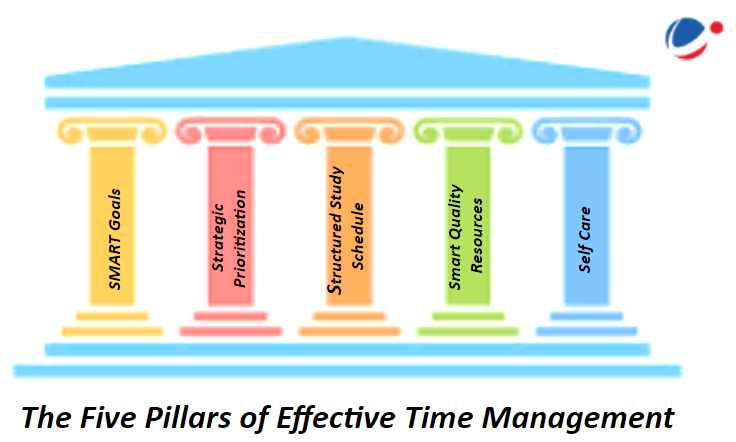
1. Setting SMART Goals
The journey to UPSC success begins with setting SMART (Specific, Measurable, Achievable, Relevant, Time-bound) goals. This framework ensures that your preparation is directed and purposeful.
- Specific: Goals should be well-defined. Instead of a vague aim to “study hard,” set a specific goal such as “complete the modern history syllabus in four weeks.”
- Measurable: Track your progress. For instance, completing a set number of chapters each week.
- Achievable: Set realistic goals that consider your current preparation level and daily commitments.
- Relevant: Ensure your goals align with the UPSC syllabus and exam pattern.
- Time-bound: Assign deadlines to keep your preparation on track.
Incorporating short-term objectives, such as weekly study targets, along with long-term goals, such as finishing the syllabus by a specific date, keeps you focused and motivated.
2. Strategic Prioritization: The Art of Focused Preparation
Within the vast syllabus of the UPSC CSE, the art of prioritization is key, blending the inherent value of subjects with insights from the analysis of Previous Years’ Questions (PYQs). This methodical approach directs focus to high-yield topics, identified through PYQ trend analysis, ensuring aspirants dedicate more effort to areas frequently emphasized in exams, such as Polity, Economy, History, Environment among others.
Simultaneously, it underscores the importance of aligning this strategic focus with personal strengths and weaknesses, urging a balanced allocation of study time to both challenging subjects and those of historical significance.
This dual-pronged strategy not only enhances the efficiency of preparation but also customizes it to fit the aspirant’s unique strengths and areas for improvement, crafting a pathway that is both focused and adaptable to the shifting priorities of the IAS preparation.
[Past 7 Years Paper’s (2017-2023): Analysis & Discussion]
3. Structured Study Schedule
Creating a study plan that you stick to every day is crucial for doing well on the UPSC exam especially for UPSC preparation for beginners. It means setting aside certain times for studying, revision, practice tests and assessment. This routine helps you stay disciplined and covers the entire syllabus properly. However, it’s important to be flexible with your plan. Sometimes, unexpected things may come up, be it college assignments, work deadlines, or personal commitments and you’ll need to adjust your schedule without getting off track.
In making your study schedule, split your time between the main GS subjects and your optional subject. This way, you can make sure you’re spending enough time on each part of the syllabus while also fitting your studies around your daily life. Being able to adapt your study times when necessary means you can keep up with your studies, even when life gets busy, making sure you’re always moving forward in your exam preparation.
4. Smart Quality Resources for UPSC Preparation
For UPSC aspirants, including those seeking the best coaching for UPSC, the choice of study materials is a pivotal aspect of their preparation strategy. The focus should be on selecting smart resources that offer clarity, depth, and are closely aligned with the UPSC syllabus. The goal is to prioritize materials that delve deep into subjects, providing a foundational and comprehensive understanding.
The process of choosing these resources can be significantly simplified by referring to expertly curated lists, which shift through the plethora of available materials to highlight those of the highest quality and relevance. This approach not only saves time but also enhances the effectiveness of study sessions, making the vast UPSC syllabus more accessible and manageable.
[Blog: Smart Resource list for UPSC Prelims]
5. Self-Care: The Effective Strategy for Peak Performance
Taking care of yourself is just as important as studying when you’re preparing for the UPSC exam. It’s easy to forget about self-care, but keeping your mind and body healthy is key to doing well. Taking regular breaks, staying active with exercise, and enjoying your hobbies can really help lower stress and stop you from burning out. When you balance study time with moments for yourself, you make sure you’re in the best shape possible for the exam.
You can also make your downtime useful for your studies. Watching educational documentaries or reading books related to the UPSC topics can be both relaxing and beneficial. This way, you turn leisure time into an opportunity to learn, keeping your preparation on track while also taking care of your well-being.
Incorporating Motivation into Your Preparation
Motivation is the fuel that keeps the engine of your UPSC preparation running. Surround yourself with success stories of those who have conquered the UPSC challenge. Engage with mentors or peer groups who share your aspirations and can offer support and motivation. Remind yourself of your personal vision for joining the civil services; let this vision drive you forward, especially during tough times.
[Blog: Toppers Learning Insights on Prelims]
Conclusion
Taking all these key pillars into account, remember that managing your time well is key to doing well on the UPSC exam. It’s not just about how many hours you put in, but how you use those hours that really matters.
Benjamin Franklin once said, “Lost time is never found again,” reminding us how important it is to use our time wisely. So, as you move forward with your preparation, equip yourself with these strategies, stay motivated, and the path to achieving your dream will be within your grasp.
Leave a Reply